Showing posts with label Mario Jones. Show all posts

Thursday, 9 August 2018

4 Easy Decision-Making Trees That Make You More Efficient

I’m going to be honest with you. I wasn’t always the most efficient person, either at home or at work. I used to say I work best under a short deadline, but in reality, I was once the queen of procrastination and left things until the last minute. Then, predictably, I scrambled to get them done.

Since then, I have tried many different ways to make me more efficient. By far and away, the best tool I’ve used is the decision tree.

If you struggling with your own lack of productivity and procrastination, then dig in for some decision tree magic:

What is a decision tree?

In layman’s terms, decision trees are the easiest and most efficient way to plan. It’s a set of either/or questions that help you take action.

It works because it helps take some of the weight off your mind—you don’t have to entertain every idea at once. Instead, you can write them all out, analyze each possible outcome once they’re out of your mind, and make the best decision from there.

The nicest thing about decision trees is they aren’t just for work. You can use them for everything—even banal things like choosing which color will look best on the walls of your living room or where you should go for dinner.

How do decision trees make you more efficient?

Before we dig into the efficiency factor, I need to introduce you to another concept—decision fatigue.

We all make hundreds of decisions every day. Do we wear the black shirt or the blue one? Do we take the interstate or the back roads to work? Do we pack a lunch or eat out?

Making so many decisions every single day is exhausting, but we do it anyway because for most of us, it’s as natural as breathing. If you’re having problems with efficiency, this decision fatigue can be the straw that breaks the camel’s back. In a cutthroat corporate world, that’s the last thing you need.

These decisions don’t just have to be about things you do, either. They can cover everything from your personal stance on politics to your preference for office chairs.

For example, you can use a decision tree to weigh the cons and pros of being sustainable at the office. You might think, “Printing less paper could reduce landfill waste, but I think better on paper.” So, you can break it down on a decision tree. Should you work primarily on your laptop or continue printing your meeting notes?

You can break nearly every decision at work down with a decision tree. (Except the one about whether you should make a new pot of coffee if you take the last cup. The answer to that is always “yes.”)

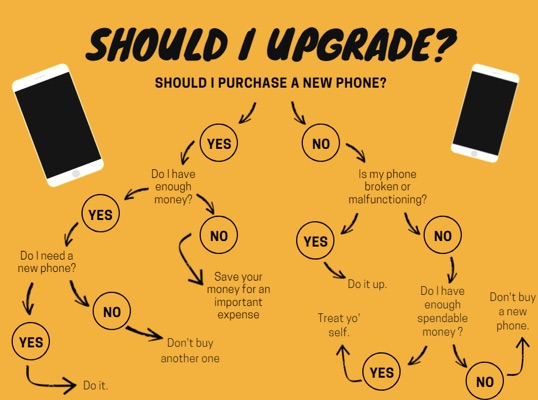
The Decision-Making Tree in Action

The decision-making tree in action

Is the decision-making tree the best efficiency tool?

While decision trees have been a blessing for me, are they really the best way to plan? Before you make your selection, let’s take a look at some of the other decision-making tools available to you, including:

  • Flowcharts — These are basically decision trees turned on their side, so if you prefer to work horizontally rather than vertically, a flowchart might be a better option for you.
  • Decision matrix — This matrix is a decision tree in the form of an Excel spreadsheet. If you have a lot of numbers to consider, it can be an excellent tool to help you keep everything straight.
  • T-Chart — These are decision trees with two branches, allowing you to break down your decisions into pros and cons.
  • SWOT — If this acronym sounds like Millennial or Generation Z slang, hear me out. This analysis allows you to break down your decisions into four categories — strengths, weaknesses, opportunities, and threats. So basically, it’s a decision tree with extra either/ors.

The purpose of all these decision-making tools is to allow you to entertain all possible outcomes before making a decision in a way that minimizes external pressure.

And while I love the basic decision-making tree for my own purposes, the variations I mentioned above might work better for you. Try them all, then stick with the one that really clicks. 

One last note: I don’t use decision trees for every little thing I decide to do, but they have taken a lot of the stress off me. They have made me more efficient in daily life, and decluttered my decision-fatigued mind. If you choose to stick with a particular decision-making tree, just don’t overuse it—you might find that it adds pressure instead of reduces it.

Use your decision-making tree to determine the #1 priority in your customizable Morning Routine…

Sign up now to get our FREE Morning Routine guide—the #1 way to increase productivity, energy, and focus for profitable days. Used by thousands of fitness, business, and finance industry leaders to leapfrog the competition while making time for the people who really matter. Learn more here.

The post 4 Easy Decision-Making Trees That Make You More Efficient appeared first on Early To Rise.

Wednesday, 8 August 2018

Why Paying Off Your Mortgage Fast is Only Sometimes a Good Idea

In 2014, The American Community Survey revealed an alarming statistic: Of all mortgage-paying homeowners in the U.S., the median home loan debt was $122,000. Even worse, the study showed that more than 50% of mortgage-paying home-owners had 2/3 or more to pay of their home’s value.

Little surprise, then, that a lot of people want to know how to pay off their mortgage.

But while a home purchase ratchets up debt, it’s also likely the single biggest investment you’ll make in your entire life.

Given the complicated balance of debt and asset that homes account for, I sat down with financial guru Dennis Miller to chat about a very sticky topic: Should we be paying off our mortgages now, or dealing with interest over the life of a 15 or 30-year mortgage?

Is it worth paying off a mortgage as soon as possible? Or even just paying a little extra each month?

Let’s start with the big picture. If an investor has a $100,000 investment portfolio, and has $100,000 in debt, their net worth is ZERO. I’m 78 years old and my experience, along with my peers, is that we really didn’t begin to accumulate wealth until we were debt-free.

Debt is renting other people’s money, and the rent is expensive. If you are borrowing to go into a business you know and understand, your money should work for you. The average working person who says they can invest and earn more money than they pay in interest is naïve. Banks make money on the differential, called the spread. If they borrow at 2% and lend at 4%, their profit is the spread—assuming the borrower does not default, which is always a risk. 

Back to home ownership, now that I’ve spelled out the interest game. I like to start by asking people this question: How much is your mortgage interest? Let’s assume they say 4%. Then the question becomes: “Can you guarantee that you will earn more than 4% after taxes in your investment portfolio for the next 20-30 years?”  Reducing interest cost is a no-risk guaranteed return.

Paying off your mortgage is both a financial and emotional decision. I can assure you that you will sleep better knowing you have no mortgage. I have never met anyone who paid off their mortgage who regretted it. 

But how does building equity in a home help someone build wealth? How can they use homeowner’s equity?

The rule of thumb is you should have enough money to live anywhere from 3-6 months (your emergency fund). When you pay off, or pay down, your mortgage, your net worth increases. Banks make it easy to have a home equity line of credit so you can borrow in case of a true emergency.

I confess to being the spender in my family for too many years. I learned I needed to make sure money was not sitting there burning a hole in my pocket. Whenever I had extra money, I used it to pay down my mortgage to keep me from doing something stupid like buying a new car when the old one worked just fine.

It looks like the Federal Reserve is going to do a couple more rate hikes this year. Does this change whether or not someone should pay off a mortgage?

Not in the least. Remember: When you are no longer a debtor, you can become a lender. That remains true regardless of interest rates.

I recently wrote an article about Fed rate hikes, which you referenced in your question. In that article, I took an example of a couple with a $200,000 mortgage. Their payments were a little over $1,000 per month. Over the life of the mortgage, they would pay almost $165,000 in interest. But that interest payment could be much higher if the Fed raises rates. Now, if that couple pays off their mortgage sooner rather than later, think of the investments they could make with that $165,000+. They could expand their portfolio or invest in higher-interest CDs, for example.

Is there any good reason why someone should not try to pay off their mortgage?

Yes, there is. Borrowing to go into a business you know and understand fits that bill. 

Here’s what I mean: In the days when financial gurus talked about using “other people’s money,” they were generally referencing buying rental property and having it appreciate while the owner collected rent checks. This was investment in a property that had a mortgage, but while mortgage payments were being made (often covered by rent checks), the property appreciated in value. The renters ultimately paid off the mortgage and the owner was able to collect rent checks that were almost completely profit.

Owning rental property is a time-consuming business, it is not passive income. Landlords lament that today’s tenants know exactly how long they can live rent-free before they can legally evict them. And there are other considerations: How much equity do you need to pay the real estate commission when you sell? How expensive is it if a tenant trashes YOUR property? Don’t underestimate the “business you know and understand.”

Is there a strategy you recommend for someone who wants to pay off their mortgage?

Yes. I had a mentor suggest this strategy to me and it literally changed my life:

Print out a monthly mortgage amortization schedule for your entire mortgage. In the example we used in the article above, the payment was $1,013.37 per month. The couple’s first monthly payment included $750 in interest. It took 15 years for half of their payment to be applied to principal. You are not building much equity when the bulk of your monthly payment goes to interest.

I was shocked when I discovered that. At the time, I was paid a salary and quarterly bonus. I started taking half of the bonus and applying it to the principal. In the first year, I took something like 5 years off my mortgage. 

Also, many people are making bi-weekly payments instead of monthly. That can knock years off your mortgage, too.

The first goal is to make sure the bulk of your mortgage payment is going to equity, not interest.    

As I mentioned earlier, a home is usually the biggest asset a person has. Should that change the way people think about their investment portfolio and asset allocation?

I urge people to think in terms of net worth. If you have equity in your home, it should hold its value—assuming you are in a decent neighborhood and keep your property in good shape. I guarantee you will sleep better not having to worry about a mortgage payment. I know many retirees who sold their big home after the nest was empty, downsized, and put the difference into investments. That is now providing for their retirement.

Before we go, I want to ask you about something I read earlier this year: There are more renters than homeowners in several of the major cities. Now that we’ve talked about paying off a mortgage, is it even worth thinking about with home prices as high they are in metropolitan areas right now?

There are times renting makes more sense. If you don’t plan on living in a home very long, you may want to rent. 

But keep in mind that whether you rent or own, you will pay the cost of home ownership. Either that means building equity yourself, or paying off a landlord’s mortgage. Over the long haul, having a home paid for is eliminating one huge monthly check. If you always rent, that monthly check is a constant.

#

Learn more about Dennis (Miller on the Money), sign up for his free newsletter, and get his free retirement report by visiting Miller on the Money online.

Set the discipline and structure needed for financial success with this vetted Morning Routine…

Sign up now to get our FREE Morning Routine guide—the #1 way to increase productivity, energy, and focus for profitable days. Used by thousands of fitness, business, and finance industry leaders to leapfrog the competition while making time for the people who really matter. Learn more here.

The post Why Paying Off Your Mortgage Fast is Only Sometimes a Good Idea appeared first on Early To Rise.

Tuesday, 7 August 2018

The 9 Biggest Business Investment Secrets of 2018

The internet is rife with content—too much, in fact. Sadly, much of it can lead you astray. At the very least, it becomes an entertaining, but unproductive time suck (we’re looking at you, Fail Blog).

That’s why ETR has curated proven, actionable advice from entrepreneurial thought leaders across multiple industries to give you immediate insight into what you should do in your business to grow exponentially.

We’re featuring several of these “thought leader roundups,” but this week we’re focusing on business investment.

Success is sometimes as much of a burden as it is a joy. For business owners, that burden often comes in the form of a very difficult question: With all of revenue, how do I know how (and how much) to invest in my business?

We’ll let the experts answer that. So without further ado, here’s the insight on how best to invest in your business from industry’s most successful movers and shakers:

Sharí Alexander, Persuasiveness Coach and “Dark Arts” Influencer

If you’re an entrepreneur, investing in your business means investing in the actual business, investing in yourself, and investing in your future. You should be making budgets for growth. What would help you expand and improve your marketing and sales? Quarterly reviews are important here. Then, you still need to invest in yourself—your physical and emotional health are mission critical for your business. If you break, chances are your business breaks. Personal trainers, therapists, etc. are just as important to helping you grow as they are to helping your business grow. PLEASE don’t overlook this. I’ve seen so many entrepreneurs ignore this part and then end up spending a BUNCH of money to try to get their health back after a heart attack or a marriage failure. Better to invest sooner than later. Lastly, you have to set aside money for your future. Sure, you probably don’t plan on “retiring” like most people, but you sure don’t want to HAVE to work in your 60s either, do you? Choose a percentage of your income to go into savings or whatever investment plan you’re comfortable with.

Zander Fryer, High Impact Coach

We learn from success and failure in our businesses. What most people don’t realize is you don’t have to learn from just your success and failures. When you learn from others you can save money, headaches, and time and having a good mentor, coach, or advisor can expedite your learning curve drastically. The first place to invest in is good mentorship and coaching.

Carrie Wilkerson, Speaker, Author, and Business Consultant

Invest wisely in what quickly replicates your effort or can increase your return. Because I’ve always taken my “shareholders'” profit very seriously (my family members), my goal has always been to say, “If I invest in this, my goal is to make it back before the credit card comes due.” That has kept me from taking on too much or spending in speculation that “someday” would be worth it. I didn’t invest in more than I could implement quickly.

Lewis Howes, Speaker, Author, and Former NFL Athlete

Invest in yourself if you want your business to take off. The more that I invest in my own growth—through coaching, workshops, masterminds, friendships, etc.—the more I increase my ability to handle my business. I am constantly overcoming limiting beliefs that are holding me back in business and the best way I’ve found to do that is through investing in my own growth. Don’t discount how valuable it is to keep growing as a person.

Kevin Kruse, Leadership and Management Expert, founder of LEADx

Don’t be cheap when it comes to hiring talent. Cash will always be tight, but hiring young, inexperienced, or mediocre talent is the wrong way to save it. You have to realize that salary and the correlation to talent isn’t linear. In other words, if you up your pay range by 30%, you can often get someone 100% better.

Sharran Srivatsaa, Real Estate and Finance Expert, founder of Kingston Lane

Think of your “only” statement. What if you could walk into a client meeting and say “We are the ONLY company in the world that can do XYZ.” Isn’t that powerful? Invest in anything that will give you that “only” statement for your business, because once you have that, you have a story that nobody can match and will make you stand out. Once you have the “only” statement, everything else becomes very easy. Before investing, ask yourself, “Does this get me closer to my ‘only’ statement?”

Noah St. John, Speaker, Author, and Business Consultant

Ben Franklin said, “The best investment you can make is to pour your purse into your head, because then you can use your head to fill your purse.” I continually invest in my own education, because that enables me to stay current on marketing and business trends, as well as discover new ways to serve our clients and customers.

Bob Burg, Speaker and Author of the “Go-Giver” Book Series

Invest your money into that which will create the (infra)structure needed so that you’re able to market, sell, produce, and provide an exceptional customer experience. Invest your time and energy into finding the right partners (employees, contractors, etc.) who will help you to do that one thing in which you’ve invested your money.

Bedros Keuilian, Founder of Fit Body Boot Camp, Author, and Coach

Invest in your own leadership skills first. Buy and read books. Go to seminars. Get a mentor, even if that means paying for coaching. Leadership is always the problem and leadership is always the solution, so if you master that first you’ll avoid the biggest pitfalls and reach growth and profits faster.

#

What business investment wisdom do you have to share? If you’ve used any of these secrets in your own business, what was the outcome? Share your stories in the comments below!

Ready to apply this investment wisdom to your business for 10x results?

>>> Fill out an application for a Perfect Life Workshop here, and let us know you want one-on-one help mapping out your path to business success! With the help of coach Craig Ballantyne, you’ll see your customer base grow, your revenue increase, and your influence spread faster than you thought possible. Let us know how we can help, and read testimonials here.

The post The 9 Biggest Business Investment Secrets of 2018 appeared first on Early To Rise.

How to Delegate for Maximum Productivity

TL;DR

  • Systems determine business success, not talent; build the right systems to ensure your development, sales, and service run smoothly
  • When you hire, be sure your candidate has skills that have a place in your company and can contribute to your longterm goals; don’t just hire for a position or a task
  • Maintain open communication with employees and provide both positive and constructive feedback for improvement; if they are not performing well, move them elsewhere in the company where their skills will be better put to use
  • Spread project execution across a larger group, giving many people the change to contribute and a clear view of how other employees work
  • Know what you should delegate and what you shouldn’t; stay in control of your finances and brand
  • Don’t confuse delegation and abdication; proper delegation allows you to retain oversight and control, while abdication turns success or failure entirely over to someone else who doesn’t have a vested interest in your company


Recently, I had the privilege of sitting down with Jonathan Cronstedt, President of e-learning company Kajabi. Cronstedt has several successful stints as CEO or founder under his belt, so I wanted to talk about the pervasive problem of bad (or no) delegation in the entrepreneurial world.

To best illustrate the lessons he learned in this arena, I decided to retrace his career steps, starting in his college days…

In the early summer of 2002, Cronstedt landed a sales job at Fletcher Jones Motorcars.

The job was, as he recalls, very regimented: “Everything funneled through the Business Development Center at the dealership, and all of the calls were scripted. It was very systematic.”

That systematic approach was a form of “designed delegation” that ensured sales representatives never left clients in the lurch—a follow-up was always delivered by staff members whose specific job was to maintain communication with prospects and customers.

This model had a huge impact on Cronstedt, who moved on to employ the same systems and strategies in the mortgage industry.

He admits that being on the “receiving” end of these marching orders made him bristle initially. But that might just be a characteristic of the sales industry: “I think sales people in particular don’t like to be told what to do,” Cronstedt said. “They think it’s their talent, not the systems they work with, that makes them successful. But they very quickly begin to realize, as I did, that it’s the systems, not the talent, that make the sales.”

This team-based approach to success was also key to Cronstedt’s successful leadership at Independent Financial Mortgage, just a few years after he left Fletcher Jones. But there were differences, too.

For instance, the Business Development model at Fletcher Jones would never have allowed managers to dip into sales, even if they were technically in charge of sales reps. For Cronstedt, that didn’t quite fit in the mortgage biz.

“Even when I built and managed teams to handle increased work, I never stopped originating loans myself. You need to know how to do something yourself before you delegate it,” he explained to me.

That led me to another question in Cronstedt’s meteoric rise: Scaling is great, and so is staying connected to the day-to-day work, but how do you know when it’s time to bring on new talent?

“When you run out of hours in the day,” he said, succinctly. “If you can’t continue to achieve individually, you’re going to have to find a way to scale the performance to meet the goals you’ve established. That comes through systems improvement or people improvement—preferably both.”

Cronstedt is quick to point out, however, that as he moved from auto sales to mortgage and beyond, what became clear was the need to constantly evaluate the systems and workload across the company. It wasn’t a quarterly thing—it happened every day.

A lot of the reshuffling of work hinged on a very simple question that Cronstedt regularly asked himself: “What tasks that don’t require higher-level skills or training can I take off the plates of senior employees and managers? How much more could they accomplish if they didn’t have to worry about those things?”

This kind of delegation touched on his own workload, as well. “Fortunately,” he said, “letting go has never been hard for me. I was more than willing to turn tasks over to someone else—if that helped the systems work as they were built to.”

“I think entrepreneurs have a hard time letting go,” he continued. “They’re too connected to everything. And even when they do, they often don’t have systems in place to set their employees up for success. So, their employees fail and the whole thing becomes a self-fulfilling prophecy. ‘See,’ they say, ‘I knew I should never have delegated that work.’”

So, I echoed, the systems make or break the company.

But there’s another way to ensure an employee is set up for success, he added: Hire the right people.

Easier said than done, of course, but that’s why there’s a system in place for hiring, too. “If we hire well, we’re confident in a candidate’s abilities. We won’t leave them hanging, even if they’re not being successful. We’ll try to find another place in the company where they will be successful.”

For Cronstedt, the guiding metrics for a successful sales hire were easy to define. But not every role can be judged easily by hard and fast numbers. Still, he argues, you need to put numbers to the hiring process—you need to be able to say, “I’m hiring this person to have X measurable impact. That means they need to have Y qualities or credentials and have accomplished Z in their career.”

At this point in our discussion, I played devil’s advocate, curious how the system would work in Cronstedt’s mind if the employee believed that he or she wasn’t being given the right kind of opportunity. “What if you place them somewhere that you think is a good fit, but they disagree?” I prodded.

“Feedback should be open,” he answered. “But that goes both ways. Take Netflix, for example. They managed to successfully move from their DVD model to streaming video and hire incredibly talented individuals while operating in a Silicon Valley world where the benefits war was often unsustainable. How? Well, one of the reasons is their open communication. If you do a good job at Netflix, you’re going to know. And if you’re doing a crappy job, you’re going to know—and know quick. That’s true across the company.”

This regular check is what keeps employees on point, and identifies mismatched skills and tasks as soon as they start to drag down performance. It also creates a culture of affirmation for employees that are very successful.

But that kind of feedback has to be bi-directional, Cronstedt says. At Kajabi, he has instituted an open-door policy for the company. This gives employees and managers the opportunity to address both good and bad performance right away—and find a fix. No more holding on to these problems for yearly reviews (that may or may not happen).

And there’s an even more ingenious way of keeping responsibilities visible across the company: Spread product execution across the organization—without siloing tasks that leave coworkers in the dark about other employees’ productivity. Cronstedt says it’s far better to spread a project across a group instead of leaving it to a single person or only a few people. Not only does this promote collaboration, but it gives employees a sense of what other skills are employed across the organization. With an open door communication policy, they can always go to the boss and say, “I think my skills could be better used here.”

“What about being a manager of managers?” I pivoted. “How involved are you still in the daily workings of the company so you can effectively train managers to lead a productive, efficient team?”

“I let a lot of it go,” he told me. “What I’ve found is that getting my hands dirty with day-to-day tasks as I’m training or guiding a manager doesn’t really build rapport or help them succeed. I like to think of it this way: ‘I’m hiring you to do this job, but I’m going to set up guardrails to make sure you are successful.’” When the right time comes, Cronstedt says, the guard rails come down.

Again, he points to the delegation issue with entrepreneurs. In some cases, as mentioned before, entrepreneurs who are emotionally connected to their entire business have a hard time letting go of work and don’t set employees up for success when they do.

But other times, they delegate eagerly—without really knowing what or why they’re delegating. Cronstedt mentioned advertising as a common example.

“A lot of entrepreneurs I know will delegate Facebook advertising, but they’ll have no idea what the outcomes should be, what their desired ROI is, or what time investment is involved. Now, I’m not going to set up a Facebook campaign myself as president or CEO of a company, but I know where it fits in my business model and I know what to expect from a given investment. Many entrepreneurs don’t, so they’ll fire an ad consultant or employee after a short period of time just because they’re not getting the results they want.”

I might have dug a bit deeper on this point, asking Cronstedt what specific areas entrepreneurs tend to delegate in ignorance, but I thought it best to close with a pointed question about 2018 delegation tips for those eager to launch their own companies.

“What is timely advice would you give ambitious startup owners in 2018?” I asked.

“First, don’t delegate things you don’t understand. Second, know what you should delegate and what you shouldn’t. For example, I think delegating accounting is great, but delegating the checkbook is not. If you’re not on top of the finances of your company and you’re assuming somebody else is going to mind the store, that’s a huge gamble.”

“Also,” he added, “I think outsourcing marketing is one thing, but outsourcing the establishment of your brand/story is not something I would let another person do. That’s yours.”

Cronstedt closed on a note of caution: “Be aware of the difference between delegation and abdication,” he said. “If you are delegating properly, you have some level of strategy in mind—some responsibility, oversight, and monitoring of execution. You start abdicating when you think things like, ‘Oh, I hired that person, so now I don’t need to touch it ever again.’”

During our conversation, Cronstedt mentioned several resources for entrepreneurs and startup owners that are helpful for management, organization, and delegation. Here’s a summary of those resources:

  • On organizational communication and culture: “Powerful” by Patty McCord
  • On productivity: Ari Meisel (arimeisel.com)
  • On organization and efficiency systems: “Work the System” by Sam Carpenter
  • On management and solution-building: “The Goal” and “Theory of Constraints” by Eliyahu M. Coldratt
  • On successful routines and productive habits: “The Perfect Day Formula” by Craig Ballantyne (FREE)

For more information about Jonathan Cronstedt and Kajabi, visit newkajabi.com.

Keep your business running smoothly with the #1 routine of entrepreneurs…

Sign up now to get our FREE Morning Routine guide—the #1 way to increase productivity, energy, and focus for profitable days. Used by thousands of fitness, business, and finance industry leaders to leapfrog the competition while making time for the people who really matter. Learn more here.

The post How to Delegate for Maximum Productivity appeared first on Early To Rise.

Monday, 6 August 2018

You’re Selling Wrong—But This is How You Fix It Using Instagram

In September of 2003, the floodgates opened. I had just launched my Turbulence Training (TT) website and was ready to send website traffic to an automated checkout that allowed me to make money overnight. It was the Holy Grail of sales.

There I was—sitting in my bedroom at an old desktop computer in an apartment I shared with two old high-school buddies. I was a broke personal trainer on the verge of the biggest breakthrough of my life.

Email marketing was my golden ticket.

For years after the launch of TT, I was blessed with the opportunity to “press send, make money.” There wasn’t a day over the next decade that didn’t net me over $1,000 through email marketing.

But things have changed. Email deliverability has gone down. Email newsletter proliferation has gone through the roof. And so has email fatigue. It still works, of course, but it’s not like the good old days.

Fortunately, people haven’t stopped buying, and I haven’t stopped putting my life’s work into new products, books, and courses.

The only thing that’s changed has been the method of purchase.

Just as milkmen and iceboxes gave way to the dairy section of your supermarket, email marketing has given way to FB ads, FB video, and more recently, my favorite new method of marketing: Instagram.

If you’ve already purchased my Instagram selling video course, then you know what I’m talking about. If you haven’t, then let me explain WHY Instagram is my method of choice.

Why email is a problem

For years now, email has been ubiquitous. It’s fair to assume that everyone has one—or multiple—emails accounts. That makes it an ideal medium for all industries. No surprise, then, that study group Radicati clocked our collective global email sends in 2017 at 269 billion.

The averages per person are almost more incredible. We receive roughly 120 emails every day and send about 40. That includes both work and personal email.

Is it any wonder we’re sick of it? Who can process that much information? No wonder that the open rate for marketing emails in 2017 averaged under 14%.

The system is, unfortunately, broken.

The Instagram (IG) solution

Fortunately for us, social media—specifically, Instagram—has saved the day.

Why is IG better than email?

One of the incredible benefits of Instagram is the opportunity it gives users to share their personality in easy-to-view video and picture stories, not just words. A simple 60-second daily video can convey much more personality, authority, and trust than a text email.

Video can be dynamic on its own, but Instagram stories allow you to do so much more with it. You can add location tags, polls, question prompts, captions (great for people who don’t turn on audio), and all kinds of styling features.

Not only does this express personality, it provides value to viewers—and gives users the chance to close videos with calls to action.

This method is so successful, my coaching client Vince Del Monte used Instagram stories to make $22,000 in coaching sales in one week. All he did was follow my instructions to post daily video stories with an effective call-to-action at the end.

I don’t see many email campaigns that bring in that kind of money (anymore) without 100,000 or more people on an email list.

One of the best ways to sell to clients on Instagram is through its unique Direct Message system. Your followers can engage with your stories and reach out to start a personal conversation. This is almost as good as sitting down with them face-to-face and demonstrating your product.

Once the conversation starts, you can lay the groundwork for a sales call or an in-person meeting to close a deal. You can even record personalized videos as messages—which never fail to impress and accelerate the sales process.

What you need to get started

Posting Instagram story videos can be a game changer for your business. But you need a few tips and tools to get started.

First, download the app Cut Story. This allows you to record longer videos, then break them up into 15-second segments for Instagram. (You can’t just post a longer video; if you want to do that, consider hosting an IG Live or recording an IG TV episode.)

Next, create a theme for the stories you’ll launch every day of the week. It’s good to repeat this as a weekly cycle, so every Monday will be a teaching Monday, for example. Build content (and value!) around this theme so that followers come to expect it.

Lastly, be consistent. If you decide you want to publish stories daily, then commit to a schedule and make sure you have the resources in place to do it. The only IG success stories come from users who are adding value every day.

#

Some people argue that email is still more effective than Instagram. But in the relatively short amount of time I have been using IG, I have found it’s far more valuable—giving users a more engaged following and a much higher conversion rate than any email marketing campaign.

With those advantages, why wouldn’t you start writing your own Instagram success story?

When you’re ready to take your IG game to the next level…

Get my Social Story Selling System video course! It’s the only tool you’ll need to turn your IG account into a “social cash machine” by building leads and easily converting those leads to loyal customers. Get the course now. >>>

The post You’re Selling Wrong—But This is How You Fix It Using Instagram appeared first on Early To Rise.

068 – How to be Resilient—Whatever You’re Facing

Never Miss An Episode!
Just add your name and email below receive a notification for each new episode!

At age 12, Stacey Copas suffered a traumatic injury on this episode of ETR Radio, she talks about how that injury became an opportunity to learn about the incredible power and importance of resilience.

You very clearly describe yourself as a resilience expert. Most people aren’t gonna really know what that means, so can you unpack that a little bit?

Resilience itself is a word that people may not have had a lot of experience with.

I see resilience as the ability to be able to encounter setbacks, whether that be adversity or change, and then be able to actually turn it into a positive, to grow from it, to use it as an asset.

A lot of people see it as it’s being able to bounce back, which I think it’s quite a narrow view of it, because the term itself, “bounce back,” implies that you’re sort of coming back to where you started, whereas I see that you’re dealing with adversity or changes, we actually learn stuff from it, and I see that we actually end up getting propelled further forward by dealing with adversity and change, and what we learn from it.

Can you give us just a brief overview of what you experienced when you were 12 that really forced you to face adversity head on?

I was cooling off in a relative’s backyard swimming pool with my younger brother and I kept climbing up on the edge of the pool and diving in. It was just an above ground pool, so it wasn’t really fit for diving, but it was something that I just kept doing.

There was one particular time that I was thinking that I was splashing too much, so I thought that if I tried to keep my legs straighter and keep my feet together as I dived in, then in theory, then I could make a really nice, clean dive and not splash.

I took a deep breath and I dived in and kept my legs straight, and it felt like any other dive that I’d done before until I went to try and swim up to the surface, and I realized I couldn’t move. I was stuck at the bottom of the pool, holding my breath.

Panic set in very quickly, I could only hold my breath for so long, and when I couldn’t hold it any longer, I had to just breathe in, and as I breathed in and my lungs filled with water and I blacked out.

Eventually my brother realized that something was seriously wrong, and he pulled me out and raised the alarm for help, and it wasn’t until later that night at the third hospital that I ended up at that a doctor came and told me that I’d actually broken my neck and drowned and that I’d never walk again.

What tools did you have at your disposal at the time to face the adversity that came to you at this young age of 12?

I was very fortunate to have good support not just from my family, but from my friends, from the school, and from the local community. I probably would have preferred to hide away and not have to deal with people at that point in time, but I ended up spending seven months in the hospital.

Through spending all that time in the hospital, my days were kept reasonably busy with therapy, and because I was so young, I ended up spending my time in the children’s ward. There was always someone to chat with.

Thankfully, I could see the outside world and I think getting out in the sunshine still is something that I try and do every single day that I find just getting connected with nature, feeling the sun on your face, and just taking the time just to appreciate what we have is a huge part of it.

How are we dealing with adversity right now?

I’m finding particularly in the businesses that I work with, that particular organizations that are going through change, a lot of people that have been quite comfortable in their jobs, and people that have been there maybe for 10, 20 years, when there is change, people can start to perceive that they’re being treated unfairly, that sometimes they even feel that they’re being bullied, and that change is personal.

What kind of specific guidelines do you have around what language is okay, or productive, versus what isn’t?

Language is actually one of the key principles that I share as part of the framework of resilience. The words that we use, not just in our communication with others, but especially in our own thought processes, those words have the power to build up people or tear them down. And changing the words that we use, and understanding the impact of words, is one of the easiest ways to actually be more resilient.

There are some words that I find really disempowering, and a few of those words is “should.”

“Should” is one word that I find so disempowering because it’s implying that you must, or … I just reframe it and say, “You could.” You could have done that. You could do that. It’s a choice, and so much of everything we do is a choice. It’s a choice on what we do, how we act, how we respond, what we think, and we can do that all by choice.

Trying to find more positive ways to describe things. Again, looking for the bright spots in things. It can be just something as simple as starting to go, “Well, what was the best part of that?” And just being very, very conscious of the words that you use, and how that frames the way that you respond to things.

The other set of words are the “what ifs,”

How do you enable people to handle adversity in a resilient way, as productively as possible?

There are certainly a number of approaches here, and particularly as far as compassion goes, I think the way to practice that initially is being compassionate and kind to ourselves, and that enables us to actually be really compassionate towards others.

I think a lot of time what happens is when we see people around us and the people that we care about struggling, a lot of people just feel they just don’t know what to do. Either they don’t know how to be supportive, or they just don’t even know what to say.

Unfortunately what that leads to is avoidance in so many ways. I encounter so many people that have had something go wrong. Whether it’s been they’ve had a failure, whether they’ve gotten divorced, whether they’ve had cancer or something like that, and they’ve said, “It’s those times where you find out who your real friends are.”

People, with not knowing what to do or say, they avoid, when really the starting point is just letting someone know, “I’m here.” Even being honest, and going, “Look, I can’t begin to imagine what you’re going through right now. I’m not really sure how I can help, and I’m not even really sure what to say, but first of all, just letting you know I am here.” That’s probably the first step.

Then the other step is, is just being consistent and being around, and actually following through on the, “I’m here.”

How are you teaching people how to help themselves get on the right track and process the dips in life?

It’s something that comes up every day. Disappointment is just an important part of life.

We learned a lot about resilience from getting bored:

  • We learned how to be resourceful.
  • We learned creativity.
  • We learned so much from life.

What kind of business teams come to you for help, coaching, and support, and what kind of teams are your sort of ideal target for the services you offer?

The majority of the clients that I work with are large organizations who are dealing with change, whether it’s a restructure, or if it’s a technology change, It’s infinite.

A lot of the time, I go and speak with their teams. I like to just have a really authentic connection with people, and just share with them. I help them to essentially change the way they look at change. Quite a few of my clients at the moment are in the media industry, so media is just being so disrupted by technology and different platforms. It’s been amazing. That’s been quite interesting.

Within that, I’m finding particularly in the media industry, in the creative industries, and particularly where people are selling, that helping people deal with rejection, because that’s something that is really, really challenging for people.

You said you’re mostly in Australia now, do you do engagements elsewhere?

Australia, New Zealand, and in 2019, I’m actually in the process of getting my US Visa, so that I can come and do some work over in the US. As much as I love Australia, and being Australian, I’m certainly excited to be able to venture out, and I do hear so often about how much Americans love us Aussies.

If people want more information, I guess the best way to follow you and get that information as well as your book is to go to your website?

Yes, go to the website, and also to follow me on pretty much any of the social media platforms. I probably find that LinkedIn and Instagram are the platforms that I’m the most active on, and I definitely welcome people actually reaching out and having a conversation.

I don’t have a team that manages all of my stuff, but if you reach out to me on social media or email, you’re getting me directly, and I just love, I love hearing what’s happening in people’s lives, what they’re working on.

The post 068 – How to be Resilient—Whatever You’re Facing appeared first on Early To Rise.

Thursday, 2 August 2018

The 3 Biggest Success Habits That Are Working for Me This Year

As the great Og Mandino wrote, “Bad habits are the unlocked door to failure.” 

On the other hand, good habits can bring us closer to our goal or mission. The definition of a habit, after all, is “a regular (repeated) tendency or practice.” 

I encourage you to ask yourself the same thing I did a few months ago: Do your current habits bring you closer to or push you away from your goals? If your answer leans a little too heavily on the latter, then you might want to try “installing” some new habits into your daily routine. And maybe I can help…

I’d like to share 3 new habits that have been working for me in 2018.  I’ll preface my unveiling by admitting that these habits aren’t earth-shattering. In fact, they are quite simple in application. Yet, if practiced consistently, you’ll enjoy some incredible benefits, i.e., enabling more peace of mind, better focus, and improved productivity. What’s more, you’ll have better practice building the good habits that set you up for success.

Habit #1: Set your phone on airplane mode while eating

This one was tough. I travel a ton for work, and spend a lot of time eating by myself. You can imagine, then, that it’s incredibly tempting to whip out my phone and scroll through the endless loops of Instagram, email, ESPN, Facebook, and LinkedIn. The next meal it’s the same thing all over again. The worst part is, it’s unbelievable the number of times I’ll do this without even noticing.

But I finally did notice. And I recognized this incessant phone use as a bad habit. So, inspired by entrepreneur and CEO Aubrey Marcus, my phone now goes into airplane mode anytime I sit down to eat. This not only gives my screen-weary eyes a break, but it also gives me the space to enjoy my meal and be present in the moment. It’s truly amazing the reflection and gratitude I can engage in while enjoying a quiet meal without digital distractions. 

Plus, taking a break from the phone charges my mental batteries so that when the meal is over, I’m ready to hit the next task of the day with full focus and energy.

Habit #2: Institute a pass/fail grading policy for your days

Craig often talks about the importance of doing a brain dump each night during the week. I’d like to tack on to that with a unique “grading” tool that puts the pressure on to achieve daily. 

Each night, write down your three most important tasks for the next day. Write “pass/fail” above them, so that your list looks something like this:

Pass/Fail
1.) Lead weekly ad revenue meeting
2.) Spend time with kids before dinner
3.) Spend 20 minutes working on writing projects

When you start the next day, you know exactly what needs to be done. If these three tasks are completed, no matter what else happens, you get a “pass” and can quote the beloved Ice Cube: “Today was a good day.” The goal, of course, is to have as many “pass” days as possible.

The real benefit to this one is the momentum you start to build after a handful of “pass” days. I’ve found myself staying up late to complete a task I otherwise would have pushed to the next day, just to keep the “pass day” streak alive. 

Don’t get me wrong.  I have plenty of “fail” days, but there’s benefit to these, too; they give me a jolt of motivation to make the next day better.

Habit #3: Visualize meetings in advance

“Visualization” is about as overused as “mindfulness” and “mediation.”  Yet, I never thought to apply the practice to sales meetings, which are the lifeblood of my craft. 

Now, I spend 10 to 15 minutes visualizing every detail of a meeting on the day it’s scheduled. I picture everything—from the moment I walk into the lobby, to the sound of my shoes on the floor, to the introduction of our team, to kicking off the agenda, to walking out of the building.  I’ll do this three or four times for a big meeting. 

The benefits are incredible. I’ve never felt more calm and prepared for a meeting—and all it took was 3 simple 10-minutes visualization exercises. It makes sense, of course; I’m so calm because I’ve literally practiced the meeting in my head for a good half-hour before it even starts.

The best part: This habit can be applied to any activity that you deem important. Spend time with your thoughts, and vividly imagine every step of the activity of importance. I guarantee it will not only put you at ease, but it will actually help you “rehearse” without needing to go through the motions.

#

What new habits are you employing in 2018 to take your life to the next level? Share them in the comments below!

Match your top-notch habits with a success-assured Morning Routine…

Sign up now to get our FREE Morning Routine guide—the #1 way to increase productivity, energy, and focus for profitable days. Used by thousands of fitness, business, and finance industry leaders to leapfrog the competition while making time for the people who really matter. Learn more here.

The post The 3 Biggest Success Habits That Are Working for Me This Year appeared first on Early To Rise.

Wednesday, 1 August 2018

How to Make Life-Affirming Decisions Using the 70% Rule

Our ability to become high achievers—in business, sports, or any of our hobbies—hinges on whether or not we can consistently make well-informed decisions. Every aspect of our lives depends on decisions in one form or another.

Most of us make decisions the same way. We collect information about each available option, assess the risks, and finally make a choice. Whether consciously or subconsciously, all of our minds go through this same risk assessment process. And while the ideal is absolute certainty in the “rightness” of our choices, real life doesn’t work that way—we often take a swing and a miss.

So how do we reconcile the desire for 100% certainty and personal benefit with the reality of less-than-ideal choices?

By doing what society’s most respected leaders have done: Employ the 70% Rule.

The 70% Rule, also called the 40/70 Rule, was introduced to the public by former Secretary of State Colin Powell. It simply states that the best time to make a decision is when you have 40-70% of the information that would ideally be available for 100% certainty.

This definition is echoed by Lily Naylor, Editor at UKBestEssays. She puts it this way: “As a leader, one of the most difficult things to do is to make decisions that I know will affect everyone, including me. By the time you have 90% of the information you need, a lot will have changed—and time is another variable you should never miss. Even if you make the wrong decision, you need to be fast in realizing it and correct your course. It’s much easier for both you and everyone that way.”

While Naylor is, of course, right about the speed of decision-making in business (and society), we have a tendency to avoid making any decisions at all because we’re not ready for the pressure of deciding on the fly. If we can’t have all of the right information to make the best decisions, we’ll just avoid making them altogether.

This pervasive procrastination is so ingrained in our lives, we don’t even realize it. But as we build on our habits of procrastination, we also build our anxiety. Unmade decisions lurk in the background, overshadowing our modest accomplishments, until they all come to a nasty head. The weight of compounded decision-making nearly crushes us.

No more. It’s time to take a different approach and leverage the 70% Rule.

Take the first step, and the rest will follow

The most common reason people procrastinate (i.e. avoid making a decision) is perfectionism. Most of us are afraid of being viewed as weak because of a misstep or miscalculation, so we plan everything to death. This perfectionism is normally a result of fixed mindsets—that success can only be accomplished in certain ways, that there is one way to be “right,” etc.

What matters more than “rightness” is improvement. In reality, nobody expects 100% perfection or certainty all of the time. It’s just not humanly possible. What they do expect is a life of strong mission and action, with self-improvement as the polestar. 

But let’s take it a step further. Casting aside the expectations of others, what would you expect of yourself? What is your life vision and how do you want to accomplish it?

With that at your back and an acceptance of imperfection as your foundation, the best way forward is the 70% Rule. For most of us, it’s the only way to begin the growth process—otherwise, we end up mired in doubts, insecurity, and questioning that never ends. 

Once you have the initial momentum afforded by the 70% Rule, the next steps up the improvement ladder will be that much easier.

Conquer decision-making anxiety

Everyone feels anxiety before they make an important decision. It’s the mind’s way of making you ask yourself a bunch of questions and ensuring a positive outcome. But while most of us—consciously or not—see anxiety as a sign that we should step back, it’s important to analyze the roots and causes of that anxiety. Sometimes, it’s merely the weight of the decision; other times, there’s a personal history or association that’s making a relatively easy decision difficult. When we remove the emotional uproar and reason through decisions we have to make, it is much easier to turn our focus to the 70% Rule.

Here’s another downside to lingering with your anxiety instead of making a decision: You’re going to miss out. As Naylor mentioned above, those who stall because of fear or doubt are not only avoiding beneficial steps toward personal improvement, but also lose opportunities to colleagues and competitors. That loss can have serious emotional, mental, and financial consequences.

Accept the risk

Are you 70% certain you want to write that book? Do you have 70% of the ideas you need to finish it? What are you waiting for? Get to writing!

Have you been working yourself to death and are 70% sure you deserve a raise? Make an appointment with the boss and make your case. The words will come once you’re in the meeting.

Here’s my point: Nothing is guaranteed in life. It takes a special kind of mindset—the growth mindset—to be courageous, to be unafraid of failure, to persist until you get what you want.

And yes, every step forward comes with some risk—the risk of failure, of pain, of humiliation, of upheaval, of anxiety. Life weaves risk together with growth. But you can’t grow until you cultivate the courage to take risks.

A recent study carried out at the University of Michigan illustrates this risk-fear-growth proposition well. In the study, participants revealed the circumstances around making various decisions in their lives. Guess what the study discovered? That fear—a fear of risk—always affects how we make decisions, whether we are aware of it or not. 

But you can conquer that fear with a little bit of self-reflection. Ask yourself:

  • What is it I’m afraid of—the process or the result?
  • What’s the worst possible (realistic) outcome of trying?
  • If I ignore this situation, do I become stronger?
  • Can I handle the outcome of not getting this done?
  • What are the gains of putting it off?
  • Am I making excuses to avoid being responsible?
  • Have I actually experienced the consequences of trying or have I just heard about them?

Commit to growth

The 70% rule isn’t just a one-off tool you use to make decisions once in a while. In the end, it’s not about what you do or don’t do, how you achieve or fail. It’s about growth—in other words, learning to face risk and move ahead despite your fears.

If you commit to this kind of growth, fired by the 70% Rule, what you’ll find is that decision-making will become easier, taking risks will become easier, your self-awareness will grow, and you’ll be able to improve by leaps and bounds in a relatively short period of time.

That growth is certainly beneficial to you, but it’s also a boon for your company, your friends, your family—anyone with whom you associate. Why? Because they, too, will be inspired to level up with the 70% Rule. As many others have said, a rising tide raises all boats.

It’s time for the tide to come in.

Build a Morning Routine with the 70% Rule in place, making time for those big self-improvement goals…

Sign up now to get our FREE Morning Routine guide—the #1 way to increase productivity, energy, and focus for profitable days. Used by thousands of fitness, business, and finance industry leaders to leapfrog the competition while making time for the people who really matter. Learn more here.

The post How to Make Life-Affirming Decisions Using the 70% Rule appeared first on Early To Rise.

Tuesday, 31 July 2018

Startup Success Stories: How Ari & Elle is Revolutionizing Gift Giving

The energetic, remarkably well-spoken, 26-year-old Shai Eisenman is nothing short of a prodigy. She finished college at the age of 18, managed an international company before the age of 20, and founded gift-giving company Ari & Elle in August 2017.

She’s also the wife of a driven entrepreneur and mother of a very lucky daughter.

How has she managed such success before the age of 30?

We had the same question, so we invited her to sit down with us to talk about her entrepreneurial journey, and how her newest venture, Ari & Elle, is changing the gift-giving industry as we know it.

Let’s start with a bit of personal background. You accomplished an impressive number of things before you turned 25. What all did you do?

Well, I won’t go back all the way, but I started college at age 15 and finished when I was 18. I was already working fulltime at that point so I had quite the hectic life as a teenager.

I’ll bet. What was the job?

I was managing a bullet-proof plate company—the kind used by a lot of security firms. I was in sales mostly, which meant I was flying all over the world, talking to military organizations and governments.

How on earth did you get into that line of work?

It’s actually a family business. I was running my dad’s company.

And then you transitioned into your first CEO position at age 20, is that right?

Well, I volunteered with the Israeli military for a year first. But then, I started working for a company called Babylon as a business development manager. I was promoted very quickly, and ended up as head of compliance before moving on to another job as a manager of several companies for an Israeli tech billionaire.

It’s hard to imagine that kind of success by your early 20s. It was also during this time that you met your now life partner, right?

I actually met him at a security conference when I was only 18. He was—and still is—a very career-driven entrepreneur with his own company, so the relationship moved slowly. We actually didn’t think anything lasting could come of it, but it did. And after six years together, we decided to have a child.

How do you manage parenting and a demanding work life?

My partner and I both understand each other and we work very hard. He understands that my travel and schedules keep me working until 2 a.m. and I understand the crazy demands of his work life.

Long ago, we decided that we would combine our careers and our parenting—not keep them separate. We look at it this way: Our daughter fits into our lives, not the other way around. That means we’re not changing our careers to accommodate her, but that we work together as a family to make our lives a success together.

To make that possible, she travels with us, goes to sleep very late sometimes, and works within our schedules. But we also make sure she gets three hours with us every day.

Have you faced any prejudice or disadvantage in your career because you’re a woman and a mother?

Oh, yes. When I was 8 months pregnant, I started attending investor meetings. At one point, one of the Indian investors said, “Whatever you tell me, I’m not going to buy it. I’m just not going to help you because the moment your daughter is born, you’re not going to want to do anything but spend time with her.”

I’ll admit—without shame or apology—that my daughter is the most important thing to me, but that doesn’t mean I don’t want to fulfill my career dreams and goals.

When I first heard this kind of feedback, I wanted to apologize. In fact, I wanted to keep all of my private life away from work. But at some point, I realized that if the person I’m working with doesn’t understand how committed I am to my career and what I’m willing to do to make it a huge success, then it’s not someone I want invested in the company.

We need more role models like that, I think. Hats off to you for taking that stand. And that’s a good transition, too, because it’s your commitment and vision that ultimately led to the creation of Ari & Elle. When did that launch?

The company was started in August 2017, but we launched the website and app in June 2018.

Ari & Elle AI-Driven Application

Ari & Elle’s AI-driven application

Oh wow—quite a new venture!

Yeah, and it’s so much fun because we’re now starting to experience some customer love. That’s amazing to me, because in all of my time running companies, there wasn’t a lot of gratification from people you were helping. What I love about Ari & Elle is that it’s all pure good—all we do is make people happy.

Can you briefly talk about the concept?

Sure. The whole idea behind Ari & Elle is to create a special, curated gift-giving experience that matches people’s personalities. It just makes the gift-giving (and receiving) so much richer.

How did you determine that this was a good business idea?

When I was living in London several years ago, I bought everything I needed online. At one point, I was shopping around for presents for a cousin and a friend. My cousin loved comic books, but I had no idea what I could get him that would fit that mold. And my cousin had just had a baby. I didn’t know what to get her either.

That’s when I thought: “What if there were a service that knows what kind of gifts to get certain people?”

I researched it, but couldn’t find anything. So, I decided to build the company myself—a gift-giving business designed around personalized gifts packaged in a very attractive way.

That sounds like a huge win for a lot of people who don’t have time to put together thoughtful gifts. But how exactly do you figure out what fits the recipient?

We have two different channels that we use—our website and our app. Both incorporate a very unique AI engine that asks questions to capture the gift recipient’s personality. Basically, it’s an avatar/bot that asks questions in a messaging format (“Ari” for male gift recipients and “Elle” for female). They’ll ask things like, “What does the recipient like to do for fun? Are they into a luxury lifestyle? Are they a free spirit?”

Based on the answers, the engine will then suggest several gift collections fitted to the personality the customer has defined.

Do you have enough gift collections to match all of the possible personalities?

I think we’re hitting most of them, and our selection is always growing. Right now, we have more than 800 different collections of more than 6,000 individual products.

What kind of market research did you do to determine what you would offer and how you would deliver it?

We went through a broad-scope research process at the outset, and determined that 45% of the gifting market is taken up by holidays and 55% by occasional gifting—for birthdays, anniversaries, and so on.

After we discovered this, we dug into the various occasions that might be important to customers. We knew that a house-warming gift, for example, is given in a very different context than, say, a get-well gift. So we wanted to see what has historically been successful for each occasion.

This research inspired our gift collections, and we continued researching and building the collections until we felt we had enough to launch the business.

Why is it necessary to create gift collections instead of single gifts?

We want to tell a story. So, for example, we have a box called “Take Me to the Movies.” It includes a small projector, an inflatable couch, and a Bluetooth speaker. It’s a cinema in a box and offers a complete experience to the recipient.

How did you land on price point? I noticed that many of the collections are $100+, which might be a bit steep for a casual thank-you or get-well gift.

We’re still working on that. We definitely want to add more collections in the $70-80 range, because we know that some people are not going to want to spend more than that on a friend or colleague they’re not all that close to.

You’ve also mentioned that you offer a picture of the final package to the gift purchaser before shipping. Why?

The first impression is important, and we know that places like Amazon don’t let you know what a gift will look like once it’s shipped. We want customers to feel confident in the gifts they’re giving—both how they’re displayed and what’s inside.

What kind of marketing are you doing to promote Ari & Elle?

We’re advertising on most of the platforms you’d expect—Good AdWords, Facebook, and so on. But we’re going to be focusing a lot more on influencer marketing in the coming weeks and months.

Part of the reason for this is that a landing page is a hard space to explain our service. But an influencer can show an audience how our service works and what you get. Their photos and videos can capture the unique elements of Ari & Elle.

Are there any lessons you’ve learned in the development process that you can share with other entrepreneurs?

Our industry is getting very digitally sophisticated. The data that’s available allows companies to find out exactly who is using their products and what their demographic information is. Because our products are so personal, we’ve tried to use that to create very targeted campaigns.

I would recommend more companies do this. It’s more work, but the conversions are higher quality.

Also, as you begin your company formation, seek out once-were founders who have become successful to help guide you through the process of building your own company. Thankfully, I did that and was able to avoid a lot of mistakes because of it.

Lastly, don’t be in a rush to launch. In retrospect, I would have spent more time marketing and fine-tuning the user interface on the site and app. The small problems we saw in beta testing didn’t seem like a big deal, but they became a big deal when we went to market.

And how do you keep happy customers coming back? What kind of ongoing communication do you have with them?

Since we’re learning about our customers as they chat with our AI engine, we can reach out and ask specific questions about searches they’ve done without purchasing a gift collection. And even when they do, we offer coupons inside gifts to encourage potential new customers to sign up with us. We also offer discounts to customers who post unboxing videos on Instagram and other social media platforms.

And, of course, we encourage feedback from customers if they have ideas on new gifts we can include.

How do you plan to grow Ari & Elle over the next 5-10 years?

We’re going to be focusing on two things: technology and merchandising.

We want to continue to improve our AI engine so users can tell us exactly what they want. That will be an ongoing process.

On the merchandise side, we’d like to round out our offerings with something that fits with almost every personality out there. As part of that, I hope to bring on a bigger team of researchers—experts who know specific careers, jobs, and industries inside and out. That will help us dig deeper into the diverse interests of our growing customer base and create the prefect gift collections for them.

For more information about Ari & Elle, and to snag the perfect gift for an upcoming holiday or special occasion, visit ari-elle.com.

The unfailing entrepreneur finds success only through routine and good habits. If you need to get on track with your business, start with this game-changing Morning Routine…

Sign up now to get our FREE Morning Routine guide—the #1 way to increase productivity, energy, and focus for profitable days. Used by thousands of fitness, business, and finance industry leaders to leapfrog the competition while making time for the people who really matter. Learn more here.

The post Startup Success Stories: How Ari & Elle is Revolutionizing Gift Giving appeared first on Early To Rise.

Monday, 30 July 2018

The 3-“Set” Solution for an Overwhelming Life

Imagine for a moment that it’s one of your busiest days. You crossed off five items from your to-do list and yet you still feel miserable because of all the things that haven’t done. And now you have to race off to take the kids to soccer or piano practice.

As you sit in traffic, you blame yourself for not being more efficient. You curse the interruptions in your day, just like you curse the car in front of you for not using its left turn signal at the light.

Worse, you’re now taking that foul mood home. A black cloud hangs over your head while you’re with the kids, affecting your ability to be present with the ones you love—the ones you are doing ALL of this for.

How many times has that happened?

Too often? Today?

Listen, you’re not frustrated because you don’t work hard, or even because you don’t work smart.

The problem is that you hope to do too many things. You (or your boss?) believe you’re capable of inhuman amounts of productivity every day.

If there is some blame to fall on you, it’s because you naïvely believe that everything is going to go exactly as planned without a single hiccup. (C’mon, you really didn’t think at least ONE of those meetings was going to run long?)

That’s not how life goes.

Here’s the bottom line: You must stop being so hard on yourself.

Better yet, let’s switch from feelings to focusing on useful action items you can implement today and tomorrow to avoid feeling overwhelmed and overworked, and start ending your days feeling accomplished and successful.

This simply requires a few small steps—what I like to call the three “sets” for an overwhelmed life. 

Step 1: Set daily alarms for important items

Struggling to leave work on time?

Set an alarm for 15 minutes before “quitting time.” When it chimes, finish that final email, do your brain dump, and create your to-do list for tomorrow. Then, put on your favorite “transition song” (a great way to make the mental move from work to personal life). Play it loudly and put it on repeat as you drive home and prepare to switch off for a few hours with your family and friends.

Struggling to end meetings on time?

First, let all attendees know not only the start time, but the end time for the meeting. Then set an alarm to go off 10 minutes before the end so that the meeting can wrap up with a summary, marching orders for everyone, and a concise statement of next steps.

Struggling to get to bed on time?

Set a reverse alarm 1 hour before bedtime. When it chimes, shut down your electronics, get ready for tomorrow, spend time with your family, draw a bath, read a book, and go to sleep! 

Step 2: Set self-care appointments

When was the last time you missed a flight? 

Never! You always make it. That proves that you can be punctual, that you can leave work on time, that you can set aside a few hours for things that matter.

You need to put your workouts, massages, meditations, etc. on your calendar just like your next flight to a conference.

Put those big rocks on the weekly calendar first, and then respect the time you’ve made for what matters. Don’t miss an appointment. No excuses. No exceptions.

Step 3: Set significant consequences 

This is the missing accountability link in many people’s lives; without it, many of us just won’t follow through.

When you skipped your workouts or lunch breaks in the past, you didn’t have significant short-term consequences. Sure, there might have been long-term hell to pay, but in that moment, you thought, “So what?”

Without significant consequences, our subconscious minds surrender to the path of least resistance. That leads us down the slippery slope towards bad habits, stress, and anxiety. 

No mas.

It’s time for you to attach significant consequences to important actions. 

This step allowed me to quit cursing in just six days. Each dirty word cost me $20. Day one totaled $120 in fines, day two was down to $80, and day three was only $40. Soon, my mind-mouth connection was re-wired to stop swearing. It’s that simple. You can break almost any bad habits simply with the right consequence.

So for you… 

Did you work through lunch again? Consequence: Pay the bill for your co-workers who actually made the time to go.

Skip that all-important workout? Consequence: No Netflix for you for a week. 

You get the idea. Pick a proportional consequence for each good habit or routine you don’t stick to.

Before you know it, you’ll be back on track and rewiring your brain to automatically engage in your best habits.

#

I promise that this 3-Set Solution will work for you. Soon, your “crazy busy days” will be fewer and further between. You’ll have more days filled with accomplishment rather than just activity.

As I like to remind my clients, this is not rocket science. Automate your actions; align them with your goals, and follow-through on your action plan. When you do, success (and work-life mastery) will come in every area of life.

You got this. I believe in you.

Keep your best habits strong by building an unfailing Morning Routine…

Sign up now to get our FREE Morning Routine guide—the #1 way to increase productivity, energy, and focus for profitable days. Used by thousands of fitness, business, and finance industry leaders to leapfrog the competition while making time for the people who really matter. Learn more here.

The post The 3-“Set” Solution for an Overwhelming Life appeared first on Early To Rise.